
What is a fixed rate ISA and who is it for?
A fixed rate ISA is a type of cash savings account that offers a guaranteed interest rate for a set period, typically between one and five years, allowing your money to grow tax-free. This makes it ideal for UK residents who want predictable returns without the risk of rate changes, especially if you can afford to lock away your funds. Unlike variable rate options, the interest rate – often quoted as AER (annual equivalent rate, which shows the true return including compounding) – stays the same throughout the term.
Eligibility for a fixed rate ISA requires you to be 18 or over and a UK resident for tax purposes, as governed by HMRC rules. You can open one if you haven’t used up your annual ISA allowance of £20,000 for the 2024/25 tax year, which runs from 6 April to 5 April. It’s particularly suited for beginners building emergency funds or saving for medium-term goals, with over 12 million UK adults holding ISAs in 2023 according to HMRC data.
Compared to easy access ISAs, fixed rate versions offer higher returns but less flexibility. For instance, while easy access might yield around 4% AER, fixed rate bonds can reach up to 4.28% for longer terms, per MoneySavingExpert’s October 2024 analysis. This guide focuses on how to open fixed rate isa, helping you navigate the process confidently.
Choosing the right fixed rate ISA
Select a fixed rate ISA by comparing interest rates, term lengths, and minimum deposits to match your savings goals and liquidity needs. Higher rates often come with longer terms or larger deposits, so balance potential earnings against access restrictions. Always check for FSCS protection, which safeguards up to £85,000 per person per institution under GOV.UK guidelines.
Current top rates hover around 4.28% AER for a one-year term, with minimum deposits starting at £500. Use comparison sites like MoneySavingExpert’s best cash ISAs guide to find deals from providers such as HSBC or Santander.
For specific providers, consider how to open a NatWest fixed rate ISA via their app for quick setup, or how to open a Nationwide fixed rate ISA through their branches for personalised advice. NatWest offers terms from one to five years with online applications, while Nationwide emphasises competitive rates for members.
| Provider | Term | AER Rate | Min Deposit |
|---|---|---|---|
| HSBC | 1 year | 4.20% | £1,000 |
| NatWest | 2 years | 4.10% | £500 |
| Nationwide | 1 year | 4.25% | £1 |
| Santander | 2 years | 4.15% | £500 |
Step-by-step guide to opening a fixed rate ISA
Opening a fixed rate ISA takes about 10-15 minutes online and involves verifying your identity and funding the account. Start by confirming eligibility to avoid issues later.
Gather required documents
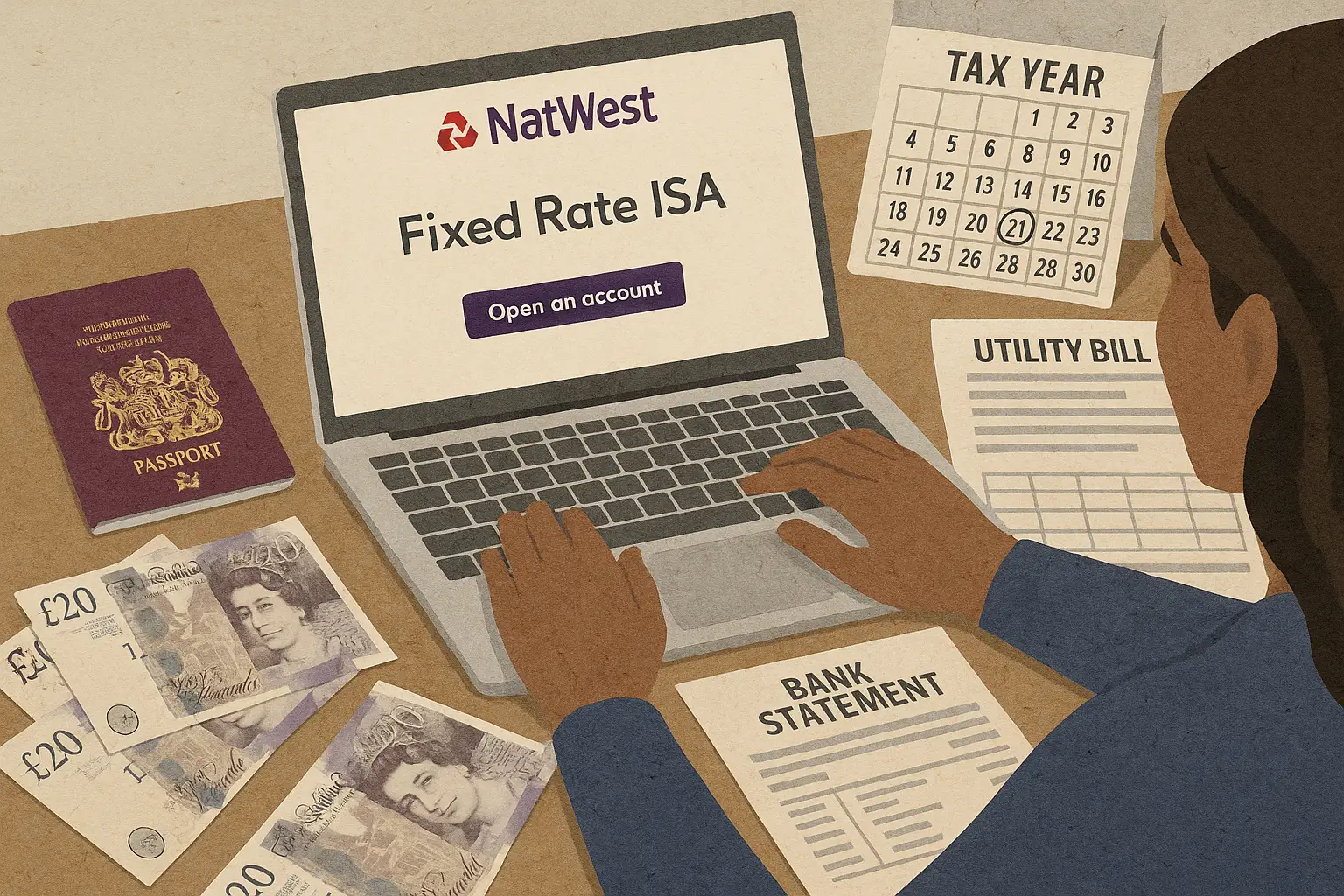
You’ll need proof of identity (passport or driving licence), address verification (utility bill), and National Insurance number. For non-UK nationals, additional residency proof may apply, as outlined in GOV.UK’s how to open an ISA guide. Have bank details ready for transfers.
Compare and select a provider
Research options using tables like the one above. For example, apply for a NatWest fixed rate ISA online at NatWest’s fixed ISA page, or visit Nationwide branches detailed on their site (note: confirm exact URL availability).
Complete the application
Apply online, by phone, or in-branch. Provide personal details and declare it’s for tax-free savings. Most providers like RBS at RBS fixed ISA use secure digital verification for speed.
Fund the account
Transfer up to £20,000 from your bank or another ISA. Interest starts accruing immediately, tax-free per GOV.UK rules.
Manage post-opening
Monitor via app or statements. Renew or transfer at term end without penalty.
Common mistakes to avoid
Don’t exceed your £20,000 ISA allowance, as unused portions don’t roll over – track via HMRC. Avoid early withdrawals, which can incur penalties up to 365 days’ interest, eroding gains.
Misunderstanding tax implications is another pitfall; while interest is tax-free, non-ISA savings may hit your Personal Savings Allowance. Always confirm provider FSCS coverage to protect funds up to £85,000.
Alternatives if fixed rate isn’t right
If you need access, consider easy access ISAs with rates around 4.51% AER but variable terms. For growth potential, stocks and shares ISAs offer higher returns with market risk.
This article is for informational purposes only and not financial advice; consult a professional for personalised guidance.
Frequently asked questions
What is a fixed rate ISA?
A fixed rate ISA is a savings account where the interest rate is locked for a fixed period, providing certainty on returns. It’s a type of cash ISA, regulated by HMRC, allowing tax-free growth up to the annual limit. Ideal for risk-averse savers, it differs from variable options by guaranteeing the AER rate throughout the term, as explained in Tembo Money’s guide.
How much can I put in a fixed rate ISA?
The maximum is £20,000 per tax year across all ISAs, per GOV.UK’s 2024/25 allowance. You can split this among providers, but exceeding it means excess funds earn taxable interest. For beginners, start small to test the waters, noting minimums like £500 for most fixed rate products.
Can I withdraw money from a fixed rate ISA?
Generally no, without penalties during the term, which can be 90-365 days’ lost interest. Some offer partial access with charges; check terms. At maturity, funds become accessible or roll over, helping avoid liquidity traps in your savings strategy.
What are the best fixed rate ISAs?
Top picks include those with 4.28% AER for one year from providers like Skipton, per MoneySavingExpert. Compare based on term and deposit; experts recommend diversifying if holding multiple ISAs. Always verify latest rates, as they fluctuate with market conditions.
Do I need to pay tax on fixed rate ISA interest?
No, all interest is tax-free within the ISA wrapper, bypassing the Personal Savings Allowance. This benefits basic rate taxpayers especially, saving up to 20% on earnings. HMRC enforces this for UK residents, making fixed rate ISAs efficient for tax planning.
How do I transfer an existing ISA to a fixed rate one?
Contact your new provider to initiate a transfer; they handle it without closing the old account, per GOV.UK rules. It must be done before 5 April to stay within the same tax year. Transfers preserve tax-free status but watch for rate differences to maximise returns.